Month: August 2025

  • The Ultimate Guide to the ICICI Bank ₹50,000 MAB Rule: Smart Move or Customer Filter?

    The Ultimate Guide to the ICICI Bank ₹50,000 MAB Rule: Smart Move or Customer Filter?


    The new ICICI Bank ₹50,000 MAB rule has stirred significant conversations across financial circles, and for good reason. Starting August 1, 2025, the private lender implemented a substantial hike in minimum average balance (MAB) requirements for new savings accounts—a move that deserves careful examination.

    While change often signals progress, this particular shift raises important questions about accessibility and inclusion. Let’s decode what the ICICI Bank ₹50,000 MAB rule means for your financial planning.

    The Numbers That Matter

    ICICI Bank’s new MAB structure represents a significant departure from previous requirements. However, the impact varies dramatically based on your location:

    Urban and Metro Areas

    • New requirement: ₹50,000 monthly average balance
    • Previous requirement: ₹10,000
    • Increase factor: A staggering 5x jump

    Semi-Urban Locations

    • New requirement: ₹25,000 monthly average balance
    • Increase factor: 5x jump from previous levels

    Rural Areas

    • New requirement: ₹10,000 monthly average balance
    • Increase factor: 5x jump from previous levels

    Importantly, existing customers who opened accounts before August 1, 2025, continue under their original MAB terms. This grandfathering approach provides some relief, though it creates a two-tier system.

    Why Banks Adjust MAB Requirements

    Understanding the rationale behind such moves helps us evaluate their merit. Banks typically adjust MAB requirements for specific goals:

    Revenue Optimization

    Higher balances increase the bank’s deposit base, providing more funds for lending. This improves the CASA ratio (a key profitability metric for banks that measures the proportion of deposits from current and savings accounts). For a deeper dive, you can learn more about the CASA Ratio on Investopedia.

    Cost Management

    Low-balance accounts often cost more in operational expenses than they generate. Higher MABs help banks streamline their customer base toward more profitable segments.

    Service Quality Focus

    With fewer low-balance accounts, banks can potentially offer better, more personalized services and enhanced digital offerings to their remaining high-value customers.

    The Upside: Enhanced Banking Benefits

    ICICI Bank hasn’t simply raised requirements without offering value. New account holders gain access to premium features:

    Transaction Benefits

    • Free NEFT transfers: No charges for digital fund transfers using NEFT (a nationwide electronic fund transfer system maintained by the RBI).
    • Complimentary cash transactions: Three free monthly transactions (₹150 + GST thereafter).
    • Waived service charges: Multiple banking charges are eliminated.

    Digital Advantages

    The bank has positioned this as a “redesigned product” with enhanced digital capabilities and priority customer service for those who meet the new criteria.

    The Concerning Side: Accessibility Questions

    This move raises legitimate concerns about the impact of the ICICI Bank ₹50,000 MAB rule on financial inclusion:

    Exclusion Risk

    A ₹50,000 MAB effectively excludes many middle-class savers, contradicting the broader trend toward greater financial inclusion.

    Penalty Structure

    Failure to maintain MAB results in charges equal to 6% of the shortfall or ₹500, whichever is lower. These penalties can accumulate quickly for budget-conscious customers.

    Opportunity Cost

    Parking ₹50,000 in a savings account earning just 2.5% annual interest represents a significant opportunity cost. These funds could generate better returns through Systematic Investment Plans (SIPs) (a disciplined investment method where you invest a fixed amount of money at regular intervals) or fixed deposits. Learn more about SIPs from the Association of Mutual Funds in India (AMFI).

    Public vs Private Banking: The Great Divide

    The contrast with public sector banks (PSBs) is striking:

    Public Sector Approach

    • State Bank of India has waived MAB penalties entirely.
    • Punjab National Bank eliminated most MAB-related charges.
    • Canara Bank and Indian Bank follow similar customer-friendly policies.

    Private Sector Strategy

    The ICICI Bank ₹50,000 MAB rule suggests a deliberate strategy to attract high-value customers, creating a clear divide in the banking ecosystem.

    Who Stays Protected?

    Fortunately, certain accounts are exempt from these higher MABs:

    Zero-Balance Options

    • Salary accounts: Complete MAB exemption.
    • PM Jan Dhan accounts: Government-backed financial inclusion accounts.
    • Basic savings accounts: Designed for low-income customers.

    These exemptions ensure essential banking services remain accessible.

    Strategic Considerations for You

    For High-Balance Customers

    If you consistently maintain over ₹50,000, the new structure might benefit you with waived charges and better service.

    For Mid-Range Savers

    Those maintaining ₹20,000-40,000 face a difficult choice: stretch your liquidity or explore other options.

    For Budget-Conscious Individuals

    Public sector alternatives become increasingly attractive. Moreover, exploring digital-first banks or cooperative banks might offer better terms for smaller savers.

    The Broader Industry Impact

    This move by India’s third-largest private bank could lead other private banks to follow, creating a more stratified banking landscape. Conversely, PSBs could attract customers seeking inclusive policies.

    Making Your Decision

    Before you react, consider your own situation:

    1. Evaluate your average monthly balance. Do you consistently meet the new requirement?
    2. Consider your banking needs. Do you use NEFT or make cash transactions frequently?
    3. Explore alternatives systematically. Compare what public sector and digital banks offer.

    The Skeptical Optimist’s View

    While the ICICI Bank ₹50,000 MAB rule makes business sense, it’s a concerning shift away from financial inclusion. The banking sector must not forget its social role in its pursuit of efficiency.

    Nevertheless, the competitive landscape ensures you have choices. Those dissatisfied can easily switch to more accommodating institutions. This development underscores the importance of staying informed and regularly evaluating if your bank truly serves your financial interests.


    Disclaimer: This analysis is for informational purposes only and should not be considered as financial advice or a recommendation to open or close any banking relationship. Please consult with qualified financial advisors before making banking decisions that could impact your financial planning.

  • India’s New Tax Bill 2025: What Changes for You?

    India’s New Tax Bill 2025: What Changes for You?


    The proposed India Tax Bill 2025 is the talk of the town, and its legislative dance affects millions. My core belief remains unwavering: financial knowledge should be accessible to everyone. Therefore, let me break down the recent developments around the India Tax Bill 2025 withdrawal and reintroduction—because this affects taxpayers across the country.

    The Political Chess Move Behind the Scenes

    On August 8, 2025, Finance Minister Nirmala Sitharaman withdrew the Income Tax Bill 2025 from Parliament. However, this wasn’t a retreat—it was a strategic recalibration. Consequently, a revised version received cabinet approval on Friday and is set for introduction on Monday, August 11.

    The government’s official reason? “To avoid confusion by multiple versions of the bill and to provide a clear and updated version with all changes incorporated.” This approach suggests they learned from feedback and want to present a consolidated document rather than piecemeal amendments.

    The Baijayant Panda Factor: 285 Recommendations

    The revised bill incorporates recommendations from the Select Committee of Lok Sabha (A parliamentary committee appointed for a specific purpose, such as examining a particular bill), led by BJP MP Baijayant Panda. Notably, this parliamentary panel delivered an impressive 285 recommendations on the draft legislation. Moreover, Panda believes the new law will simplify India’s decades-old tax structure and reduce unnecessary litigation for both individuals and MSMEs (Micro, Small, and Medium Enterprises).

    While this sounds promising, the sheer volume of recommendations raises questions. Can 285 changes truly simplify a system, or might they inadvertently add new layers of complexity?

    The Simplification Promise: Bold Claims Under Scrutiny

    What the Numbers Tell Us

    The current Income Tax Act of 1961 contains:

    • Over 4,000 amendments
    • More than 5 lakh words
    • Six decades of accumulated complexity

    The new India Tax Bill 2025 promises to reduce this complexity by “nearly 50 percent.” Additionally, CBDT (Central Board of Direct Taxes, the authority that administers direct taxes in India) Chairman Ravi Agrawal suggests the law will become “far more simpler for any taxpayer to read and understand.”

    The Three Guiding Principles

    The government has outlined three key principles:

    1. Textual and Structural Simplification

    • Improved clarity in language
    • Better organization of provisions
    • Use of formulae and tables

    2. No Major Tax Policy Changes

    • Ensuring continuity for taxpayers
    • Maintaining existing framework

    3. No Modification of Tax Rates

    • Preserving predictability
    • Avoiding disruption to planning

    The Money in Your Pocket: 5 Tangible Benefits

    Despite claiming “no major tax policy changes,” the bill introduces significant financial benefits for middle-class taxpayers:

    Key Changes in Numbers

    1. Increased Rebate Threshold: The tax rebate limit is proposed to increase from Rs 7 lakh to Rs 12 lakh. This is a 71% increase in the eligibility threshold.
    2. Enhanced Rebate Amount: The maximum rebate amount jumps from Rs 25,000 to Rs 60,000—a massive 140% increase in potential savings.
    3. Continued Marginal Relief: This relief (A tax provision to ensure that the increase in tax liability is not more than the increase in income when an individual’s income just crosses a certain threshold) will apply to those earning slightly above Rs 12 lakh, preventing sudden tax burden jumps.
    4. Boost for New Tax Regime: These changes primarily benefit those opting for the new tax regime under Section 115 BAC (the section of the Income Tax Act that provides for an optional new tax regime with lower slab rates but fewer exemptions and deductions).
    5. Potential Consumption Boost: More money stays in middle-class pockets, potentially boosting national consumption and investment.

    The Skeptical Optimist’s Reality Check

    While celebrating these developments, experience compels me to raise critical questions:

    Question 1: Can Complexity Really Be Halved?

    Tax law inherently deals with countless scenarios. Simplifying language doesn’t necessarily simplify the economic realities it governs. Will this 50% reduction in complexity translate to genuine ease for taxpayers, or will new interpretations emerge from the India Tax Bill 2025?

    Question 2: Policy Changes vs. No Policy Changes?

    The government states “no major tax policy changes,” yet increasing rebate thresholds from Rs 7 lakh to Rs 12 lakh is a monumental policy shift affecting millions. While beneficial, this contradicts the stated principle. How does the government plan to offset the reduced tax collection? This is a crucial question, especially when considering the broader paradox of Indian tax collection where revenue dynamics are often complex.

    Question 3: Implementation Challenges Ahead

    Large-scale legislative reforms often bring unforeseen consequences. The tax department’s capacity to handle queries during the transition to the new framework remains unclear. Will taxpayers face processing delays or confusion?

    Winners and Potential Concerns

    Clear Winners

    • Middle-class taxpayers earning up to Rs 12 lakh
    • Small businesses and MSMEs seeking simpler compliance
    • Tax professionals dealing with clearer provisions

    Potential Concerns

    • Government revenue impact from increased rebates
    • Implementation challenges during transition
    • Possible new complexities despite simplification claims

    The Road Ahead: Cautious Optimism

    The India Tax Bill 2025 represents a genuine attempt to modernize our tax framework. The true test lies in implementation. While increased rebates provide immediate relief, the simplification promise needs practical validation.

    Furthermore, the government must address the contradiction between claiming “no major policy changes” while implementing substantial rebate increases.

    What This Means for You

    If you’re earning up to Rs 12 lakh annually and using the new tax regime, expect significant savings. However, don’t assume the new law eliminates the need for professional guidance entirely. Complex financial situations will likely still require expert consultation. Stay informed and maintain proper documentation.

    Final Thoughts: Evolution, Not Revolution

    This legislative effort, much like the long-term journey with GST, shows the government’s commitment to taxpayer-friendly policies. However, calling it revolutionary might be premature. Instead, it represents evolutionary progress—welcome changes that address genuine concerns while raising new questions.

    The withdrawal and reintroduction strategy suggests the government takes feedback seriously. Consequently, this collaborative approach between lawmakers and stakeholders could set a positive precedent for future reforms.

    As the revised bill moves through Parliament, the financial community awaits practical implementation details that determine whether these noble intentions translate into genuine ease for taxpayers.


    Disclaimer: This analysis is for informational purposes only and does not constitute financial or tax advice. Consult qualified professionals for guidance specific to your situation. This is not a buying recommendation.

  • Policybazaar Hit with ₹5 Crore Fine: What This Means for You

    Policybazaar Hit with ₹5 Crore Fine: What This Means for You


    The digital revolution has transformed how we buy insurance, but this Policybazaar fine explained analysis shows why consumers must be cautious. When regulators impose hefty penalties, it’s time to understand what’s happening behind the glossy screens. The IRDAI [Insurance Regulatory and Development Authority of India] recently slapped Policybazaar with a substantial ₹5 crore fine, raising crucial questions about the transparency of online insurance platforms.

    This penalty wasn’t arbitrary. It stemmed from multiple regulatory violations that directly impact you. Let’s break down what went wrong.

    Why IRDAI Took Action: The Core Issues

    1. Biased Product Rankings: The “Best Plans” Deception

    Perhaps the most concerning issue was how Policybazaar presented insurance products. The platform displayed certain plans as “top” or “best” without providing transparent criteria, creating a significant conflict of interest.

    Here’s what the IRDAI investigation revealed:

    • Only 5 ULIP products [Unit Linked Insurance Plan, a product that combines insurance and investment] were shown despite partnerships with multiple insurers offering similar plans.
    • The health insurance section featured “top plans” from just 12 insurers, even though agreements existed with 23 companies.
    • No clear methodology was provided for these rankings.

    This practice limits genuine choice and violates IRDAI guidelines that prohibit web aggregators from ranking products to favor specific insurers. The regulations are clear: terms like “best” or “top” can only be used when backed by verified, third-party data that is transparently disclosed.

    2. Premium Payment Delays: A Serious Compliance Breach

    Financial responsibility is the backbone of insurance. Unfortunately, Policybazaar was found delaying premium remittances to insurers, a direct violation of Section 64VB of the Insurance Act, 1938 [a law mandating that insurance risk cannot be assumed before the premium is received by the insurer]. For more details, you can read a breakdown of this section on The Insurance Times.

    The numbers tell a troubling story:

    • 67 sample policies showed delays exceeding 30 days.
    • 8,971 policies experienced delays between 5-24 days.
    • Another 77,033 policies had premiums remitted after three working days.

    The law mandates premium remittance within 24 hours. These delays can create dangerous coverage gaps, leaving you vulnerable when you need protection most.

    3. Missing Sales Records: A Lack of Transparency

    Accountability requires proper documentation. The investigation found Policybazaar sold over 97,000 policies via telemarketing without mapping them to Authorized Verifiers (AVs) [individuals responsible for verifying the information provided by a customer during a remote sale]. Out of 4,32,366 telemarketing policies, a staggering 97,780 remained “unassisted” or “unmapped.”

    This makes it impossible to determine who actually sold these policies and what was said, raising serious questions about sales practices and customer protection.

    Policybazaar Fine Explained: What It Means for You

    While the penalty highlights serious issues, it also signals positive developments for the insurance sector.

    Regulatory Vigilance Protects Consumers

    IRDAI’s decisive action, which is detailed on the official IRDAI website, demonstrates that digital convenience cannot come at the expense of transparency. This vigilance ultimately benefits consumers by:

    • Ensuring fair product representation.
    • Maintaining proper financial protocols.
    • Protecting customer interests through proper documentation.

    Industry-Wide Improvements Expected

    This penalty serves as a wake-up call for all online aggregators. Companies will likely now strengthen compliance, improve transparency in rankings, and invest in better record-keeping.

    What Insurance Buyers Must Do Now

    This incident is a valuable learning opportunity. Here’s how you should adapt your insurance buying strategy:

    1. Look Beyond “Top Plans” Labels
    Don’t rely solely on platform rankings. Instead:

    2. Verify Premium Payment Processes
    Understand how your premium is handled:

    • Confirm remittance timelines with the platform.
    • Keep payment receipts and policy documents safe.
    • Follow up immediately if policy issuance seems delayed.

    3. Maintain Your Own Records
    Documentation is your best defense:

    • Save all email communication.
    • Keep copies of application forms.
    • Document any important telephonic conversations, including the time and agent’s name.

    The Broader Implications

    This Policybazaar fine explained the core tension in digital finance: innovation must not compromise integrity. The insurance sector thrives on trust. When platforms manipulate product displays or mismanage funds, they undermine this foundation, making regulatory action necessary.

    Despite this, online aggregators still offer value by democratizing access to information. The key is ensuring they operate within the rules. PB Fintech, Policybazaar’s parent company, stated the penalty won’t impact operations, but its shares still declined 2.3%, showing that the market takes regulatory compliance seriously.

    Final Thoughts

    This incident reinforces why understanding the rules matters. Digital platforms offer convenience, but you must remain vigilant. The future of digital insurance depends on balancing innovation with robust consumer protection. This penalty, while significant for one company, will hopefully catalyze positive changes across the entire online insurance landscape.

    Therefore, as you embrace digital finance, remember that convenience should enhance, not replace, your own due diligence.


    Disclaimer: This analysis is for informational purposes only and should not be construed as financial advice or a recommendation regarding insurance purchases or company investments. Always conduct independent research and consult qualified advisors before making financial decisions.

  • Highway Infrastructure IPO: Is the 27x Rush a Trap?

    Highway Infrastructure IPO: Is the 27x Rush a Trap?

    The Highway Infrastructure IPO has investors talking, and it’s easy to see why. This offering was oversubscribed by a spectacular 27 times, creating a frenzy. But before you get swept up in the euphoria, a word of caution: powerful market momentum doesn’t always guarantee a safe investment, as we’ve seen in other cases where 100x oversubscription tells only half the story. Let’s dissect both the dazzling hype and the hidden risks of this infrastructure story.

    The Numbers That Turned Heads

    The Highway Infrastructure IPO commanded attention from the moment it launched. The ₹130-crore public offering, which opened on August 5, 2025, showcased a remarkable appetite from the market.

    Key Subscription Metrics:

    • Overall Subscription: 27 times oversubscribed (meaning demand was 27 times higher than the shares available).
    • Retail Investors: 29 times subscription rate.
    • Non-institutional Investors: 33 times booking.
    • Institutional Buyers: 5 times subscription.
    • Grey Market Premium (GMP): Over 57% (GMP is the price at which IPO shares are traded in an unofficial market before they are listed on the stock exchange. A high GMP often suggests a strong listing is expected. You can learn more about GMP here at Investopedia).

    Even before the public offering, the company secured ₹23.40 crore from anchor investors (investors who are offered shares in an IPO before it opens to the public), including HDFC Bank and Abans Finance Pvt. Ltd. This early backing signals institutional confidence, but it’s no guarantee of success for retail investors.

    What Highway Infrastructure Actually Does

    Highway Infrastructure Ltd. (HIL) is more than just a construction company. The Indore-based firm, incorporated in 1995, has strategically diversified its operations across several key verticals.

    Business Verticals:

    • Tollway collection operations.
    • Engineering, Procurement, and Construction (EPC) projects.
    • Real estate development.
    • Road, highway, and bridge construction.
    • Residential project development.

    The company reported a total income of ₹504.48 crore with a profit after tax of ₹22.40 crore. The IPO proceeds are earmarked for working capital requirements (₹65 crore) and general corporate purposes.

    The Bullish Case: Why Investors Are Excited

    Several factors fuel the positive sentiment around this IPO. First and foremost, India’s massive infrastructure push creates a fertile ground for companies like HIL.

    Growth Catalysts:

    • Government Spending: The government’s unwavering focus on highway development provides a robust pipeline of potential projects, similar to the growth seen in other government-backed sectors.
    • Diversified Revenue: Multiple income streams across toll collection, EPC, and real estate reduce dependency on a single segment.
    • Established Presence: Nearly three decades of operational experience builds credibility.
    • Strong Subscription: The overwhelming market response reflects high investor confidence in the Highway Infrastructure IPO.

    5 Critical Risks to Consider Before Investing

    Excitement must be balanced with a sober assessment of the risks. Here are five red flags that demand your attention before you make an investment decision.

    1. Revenue Concentration Concerns

    The company is heavily dependent on contracts from the National Highways Authority of India (NHAI) for its tollway business. You can visit the official NHAI website here to see the scale of their projects. Similarly, most of its EPC revenue comes from public sector clients. Losing a single major contract could significantly harm its financial performance.

    2. Geographical Limitations

    HIL’s operations are heavily concentrated in specific regions of India. This lack of geographical diversification means that any adverse local developments—such as economic slowdowns, regional policy changes, or political instability—could disproportionately impact the entire business.

    3. Short-Term Contract Challenges

    NHAI tolling contracts typically run for only one year, with limited possibilities for extension. This short-term structure creates constant pressure on the company to continuously bid for and win new projects, introducing uncertainty into its revenue stream.

    4. The Capital-Intensive Reality

    Infrastructure is a cash-hungry business. It requires massive capital for equipment, materials, and labor. If HIL faces cash flow problems or struggles to manage its debt, its operations could be severely hampered. Strong liquidity management is non-negotiable, as the performance of infrastructure companies can be complex; sometimes even becoming debt-free isn’t enough to boost the stock.

    5. Potential Conflicts of Interest

    Investors must be vigilant about related-party transactions. The company’s promoters have business interests in other, similar companies. Furthermore, HIL engages in projects with these related parties, which could create potential conflicts of interest that may not always align with shareholder value.

    The Final Verdict

    The Highway Infrastructure IPO presents a classic case of opportunity versus risk. The strong subscription numbers and HIL’s established presence are compelling, but they don’t tell the whole story.

    Key Takeaways:

    • Positives: Proven track record, diversified business model, strong sector tailwinds from government spending, and a fantastic market reception.
    • Risks: High dependency on government contracts, regional concentration, short contract tenures, a capital-intensive model, and potential conflicts of interest.

    Making Your Investment Decision

    Instead of chasing the crowd, your decision should be based on your personal financial goals and risk tolerance. It’s crucial to look past the initial excitement, just as investors must be cautious when a stock jumps 1600% in a single day.

    Ask Yourself:

    • Does my portfolio need exposure to the infrastructure sector?
    • Can I tolerate the volatility tied to government contract cycles?
    • Am I comfortable with a company whose fortunes are tied to specific regions?

    The Bottom Line

    The Highway Infrastructure IPO is a reflection of the broader optimism in India’s growth story. The company operates in a vital sector with long-term potential. However, the risks tied to contract dependency, geographical concentration, and high capital needs are very real.

    Ultimately, thorough due diligence will always trump market hype. Similar to our analysis of the HDB Financial IPO, a smart investment is one made with a clear-eyed view of both the shining opportunities and the critical risks.


    Disclaimer: This analysis is purely for informational and educational purposes based on publicly available information. It should not be construed as financial advice or a recommendation to buy or sell securities. IPO investments carry inherent risks, and readers should conduct independent research and consult qualified financial advisors before making investment decisions.

  • Aditya Infotech IPO Analysis: Why 100x Oversubscription Tells Only Half the Story

    Aditya Infotech IPO Analysis: Why 100x Oversubscription Tells Only Half the Story


    The Indian stock market just witnessed something remarkable – yet another IPO that grabbed headlines with triple-digit oversubscription numbers. Aditya Infotech, the video security company behind the CP Plus brand, made its debut on August 5, 2025, with all the fanfare of a blockbuster opening. But here’s what every investor needs to know: spectacular debuts don’t guarantee spectacular futures.

    My core belief remains unchanged – financial knowledge should be accessible to everyone, and it’s our mission to cut through the noise with clarity and a touch of reality check. Today, let’s examine what made this IPO sizzle and what questions smart money should be asking in this detailed Aditya Infotech IPO analysis.

    The Company That Caught Everyone’s Attention

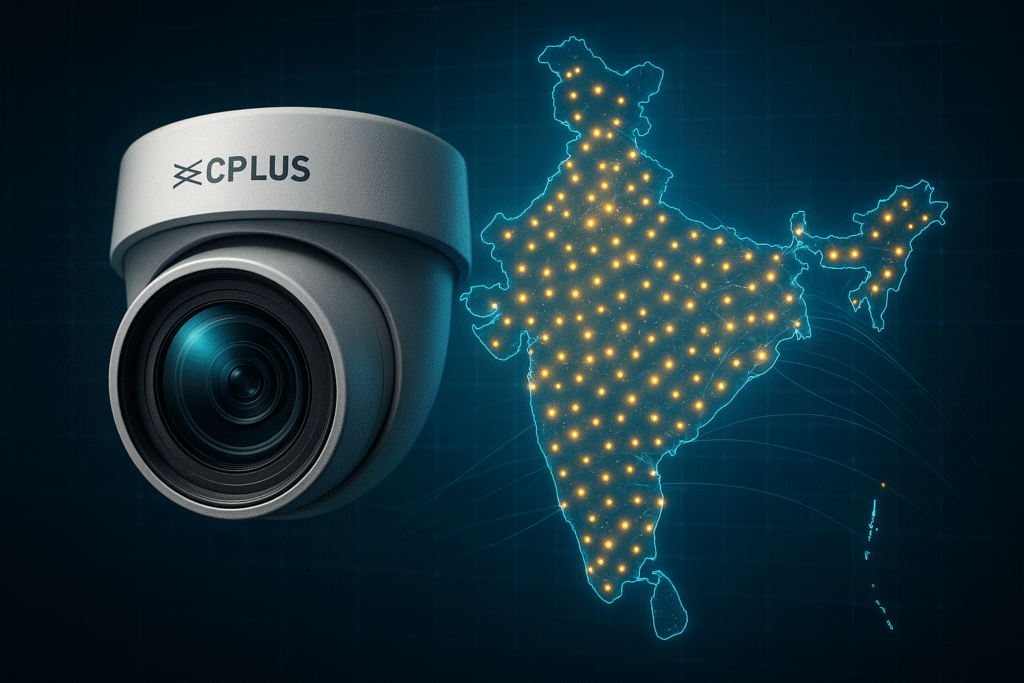
    What Aditya Infotech Actually Does

    At its core, Aditya Infotech operates in the video security and surveillance space, primarily known for its CP Plus brand. The numbers paint an impressive distribution picture:

    • Geographic reach: Over 550 cities and towns
    • Distribution network: More than 1,000 distributors
    • Integration partners: 2,100 integrators
    • Product range: Smart home IoT cameras, AI-powered security systems, industrial surveillance equipment

    This infrastructure positions the company strategically within India’s expanding digital security landscape.

    The Financial Performance That Turned Heads

    FY25 delivered some eye-catching numbers:

    • Revenue: ₹3,123 crore
    • Net profit: ₹351 crore
    • Year-on-year profit growth: An astonishing 205%

    That 205% profit growth deserves attention, raising the critical question: is this sustainable, or are we looking at a one-time jump?

    The IPO Numbers: Impressive, But What Do They Really Mean?

    Subscription Statistics That Made Headlines

    The IPO, priced at ₹675 per share, closed with oversubscription figures that dominated financial news:

    • Overall oversubscription: 100.69 times
    • QIB category: 133.21 times oversubscribed
    • NII segment: 72 times oversubscribed
    • Retail investors: 50.87 times oversubscribed

    Total funds raised: A significant ₹1,300 crore.

    The Listing Day Performance

    When markets opened on August 5, 2025, Aditya Infotech shares delivered a powerful debut:

    • Listing Premium: Over 50% on both NSE (₹1,015) and BSE (₹1,018).
    • Market Capitalization: Approximately ₹11,900 crore.

    The Anchor Investor Validation

    Before the public, the company secured ₹582.3 crore from 54 institutional anchor investors, including global heavyweights like Goldman Sachs, the Government of Singapore, and the Abu Dhabi Investment Authority. This backing provides credibility, but remember – their goals might differ from yours.

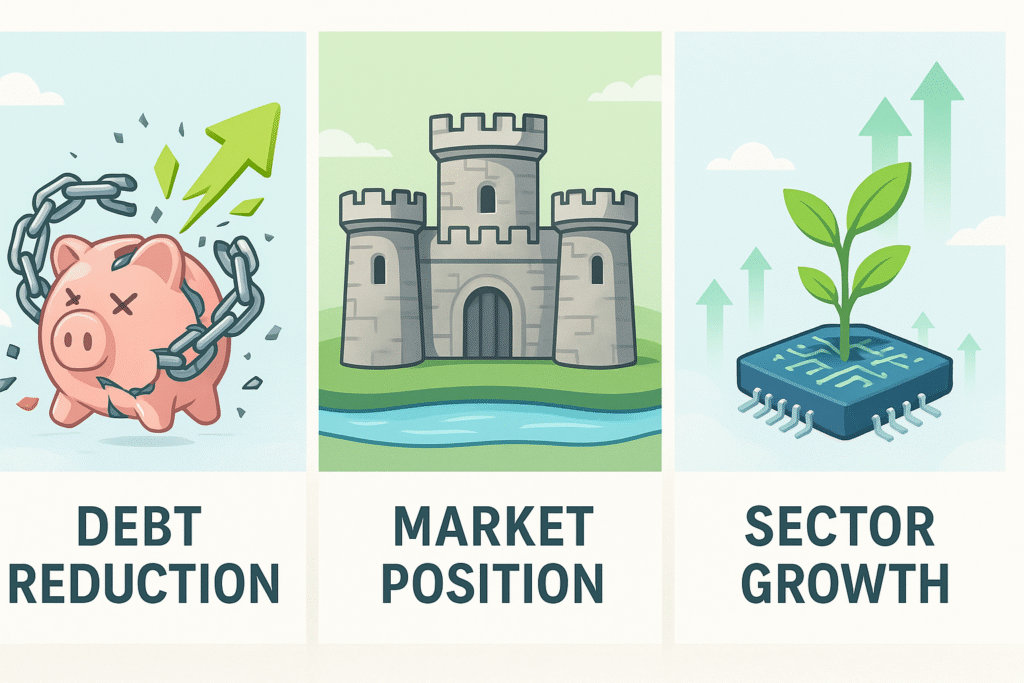
    The Positive Case: 3 Reasons Investors Are Excited

    1. Strategic Debt Reduction Plan
      A whopping ₹375 crore from the fresh issue is earmarked for debt reduction. This focus on balance sheet strength signals a commitment to financial discipline, though a stronger balance sheet doesn’t always guarantee an immediate rally.
    2. Market Positioning Advantages
      The company’s established distribution network creates natural barriers to entry. Building these relationships doesn’t happen overnight, providing a solid competitive moat.
    3. Sector Tailwinds
      India’s security infrastructure spending is expanding rapidly, driven by urbanization, smart city initiatives, and rising security consciousness.

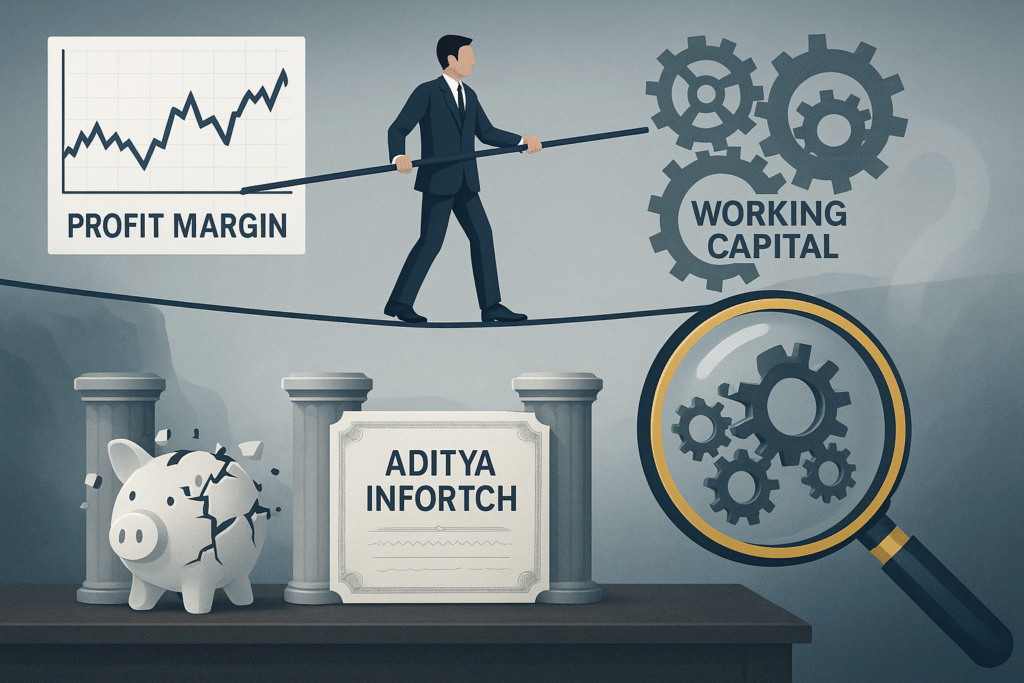
    The Skeptical Questions Every Investor Should Ask

    1. Can Margin Consistency Be Maintained?
      The security hardware business is competitive. Can Aditya Infotech protect its profitability against pricing pressure or supply chain issues?
    2. Working Capital Efficiency Concerns
      Distribution-heavy businesses live or die by their working capital management. Inventory, receivables, and payables will be key to watch in quarterly results.
    3. Value Chain Evolution Strategy
      Can the company evolve beyond distribution into higher-margin integrated solutions or analytics? Standing still in tech means falling behind.
    4. Concentrated Promoter Control
      While market leadership is an advantage, long-term valuation depends heavily on management’s execution. This is a vital point in any Aditya Infotech IPO analysis.

    What Smart Investors Should Monitor Going Forward

    • Quarterly Performance: Keep an eye on revenue growth, margin trends, and debt reduction progress.
    • Strategic Moves: Watch for new products, acquisitions, or international expansion plans.
    • Competitive Landscape: Monitor how the company responds to new tech trends like AI and cloud integration.

    The Bottom Line: Beyond the IPO Euphoria

    Aditya Infotech’s strong debut reflects genuine market interest. The oversubscription numbers indicate massive investor appetite, and institutional backing provides validation.

    However, spectacular listings don’t guarantee spectacular long-term performance. The real test begins now – in quarterly earnings calls, strategic execution, and market adaptation.

    For potential investors: The stock’s current premium pricing likely reflects much of the near-term optimism. Focus on fundamentals, not hype.

    For existing shareholders: The next 12-18 months will be crucial. Monitor the company’s ability to deliver on its promises.


    Disclaimer: This analysis is for informational purposes only and should not be construed as investment advice. Investors should conduct their own research and consult with qualified financial advisors before making investment decisions. Past performance does not guarantee future results.

  • Is This a Trap? 5 Critical Signs from Our Indian Market Bounce Analysis

    Is This a Trap? 5 Critical Signs from Our Indian Market Bounce Analysis


    August 4, 2025

    After Friday’s brutal selloff, Monday’s market surge brings a critical question to every investor’s mind. Our Indian market bounce analysis aims to determine: Is this genuine strength, or are we witnessing a classic dead cat bounce [a temporary, short-lived recovery in asset prices from a prolonged decline or a bear market that is followed by the continuation of the downtrend]?

    My core belief is that financial knowledge should be accessible. Today’s action perfectly illustrates why understanding both sides of the story matters more than following the crowd.

    Dissecting the Green Surge: What Actually Happened

    1. Index Performance Shows Cautious Optimism

    The numbers tell an interesting story. The BSE Sensex opened 217.61 points higher at 80,817.52, while the Nifty climbed 71.55 points to 24,636.90. By 11:01 AM, these gains had moderated slightly – the Sensex trading up 151.05 points (0.19%) and the Nifty up 65.70 points (0.27%).

    This isn’t euphoria. It’s measured optimism, a crucial distinction in our Indian market bounce analysis.

    2. Sector Rotation Reveals Market Psychology

    The day’s biggest story wasn’t just the overall bounce—it was where the money flowed:

    Auto Stocks Break Their Losing Streak

    • Nifty Auto index jumped 1%, snapping three days of losses.
    • Hero MotoCorp led the charge with a robust 21% sales increase in July 2025, dispatching 449,755 units.

    Metals Find Their Footing

    • Nifty Metal index rose 0.7%, also breaking a three-day decline.
    • Tata Steel and SAIL emerged as prominent gainers, suggesting investors are betting on industrial recovery.

    Individual Company Stories: The Real Market Drivers

    Strong individual performances provided the backbone for the market’s fragile confidence.

    Defense Sector Shows Resilience

    After an 8% decline over eight sessions, defense stocks like GRSE and BEML bounced back up to 3% today. The sector’s recovery was supported by concrete order wins:

    • Titagarh Rail Systems secured orders worth ₹1,598.55 crore for Mumbai Metro Rail Project.
    • Axiscades Technologies bagged a ₹223.95 crore defense contract for tank transporter trailers.

    Infrastructure Gets a Boost

    L&T’s renewable energy business landed a sector-defining project: a 116 MWac solar plant with 241 MWh battery storage in Bihar. This marks the largest such project awarded by a state utility in India, signaling serious government commitment to renewable infrastructure.

    MCX Delivers Double Delight

    MCX shares surged 5% following strong Q1 results and a 1:5 stock split announcement. This shows how corporate actions can instantly energize investor sentiment, even in uncertain times.

    The Reality Check: 3 Sobering Risks in This Market Bounce

    No Indian market bounce analysis is complete without acknowledging the massive headwinds that caused Friday’s carnage. These issues have not disappeared.

    3. Global Headwinds Remain Unchanged

    • US Market Turmoil: The S&P 500 recorded its largest daily drop in over two months on weak US jobs data, triggering fresh recession fears.
    • Trade Uncertainty: New US tariffs on multiple trading partners added to global instability.

    4. Foreign Investment Flight Continues

    FIIs (Foreign Institutional Investors) pulled out ₹3,366.40 crore on Friday alone. While DIIs (Domestic Institutional Investors) bought ₹3,187 crore, the net outflow signals deep concern from global funds. This kind of activity is a critical signal for retail investors, similar to the recent mega trades that rocked D-Street. For more on how FIIs and DIIs impact markets, you can read this explainer from the National Stock Exchange (NSE).

    5. Key Sectors Are Still Lagging

    Not everything was rosy. The laggards tell a powerful story about where the real risks lie.

    • Technology Troubles: The IT index extended its fall for a third consecutive day, with Infosys and HCL Tech dragging. This suggests global IT spending concerns persist.
    • Banking Stress: Private bank stocks like Axis Bank and ICICI Bank traded lower, unable to participate in the rally.

    Corporate Earnings & Brokerage Caution: A Mixed Bag

    • The Disappointments: ABB India shares fell 6% on a muted outlook. Muthoot Capital Services and Graphite India both reported declining profits.
    • Brokerage Caution: Nomura downgraded Federal Bank to ‘neutral’, while Goldman Sachs maintained ‘neutral’ on Delhivery, citing profitability concerns.

    The Macro Question That Changes Everything

    Here’s the critical insight: VK Vijayakumar from Geojit Investments highlights that market direction now hinges entirely on US-India trade deal negotiations.

    • Positive Scenario: Tariffs at 20% or below could be a massive catalyst.
    • Negative Scenario: 25% tariffs remaining could cause the market to drift downward.

    This isn’t just policy noise—it’s the fundamental variable that could destroy current market valuations.

    The Federal Reserve’s Dangerous Twist

    The latest US jobs data strongly suggests a September rate cut is coming. But here’s the twist: with tariff-driven inflation, a stagflationary scenario [an economic condition of high inflation combined with stagnant economic growth and high unemployment] cannot be ruled out. (You can learn more about this complex topic on Investopedia). Markets celebrating rate cuts might be ignoring the bigger inflation picture.


    What This Means for Your Portfolio

    This comprehensive Indian market bounce analysis reveals that today’s bounce offers hope, but wisdom demands acknowledging the risks.

    Opportunities Exist:

    • Infrastructure, renewables, and defense show clear, order-backed growth.
    • The auto sector’s recovery points to resilient domestic demand.

    But Global Risks Are Real:

    • US trade policy remains a dark cloud over export-dependent sectors like IT.
    • FII outflows could accelerate if global sentiment deteriorates.

    The Bottom Line

    This Monday’s action represents cautious positioning, not a full-blown recovery. Smart money isn’t betting on overall market direction right now. It’s betting on specific stories with clear catalysts while remaining prepared for volatility.

    Remember: in markets, being right about timing matters less than being right about trends. Today’s bounce is temporary relief, but the underlying shifts in infrastructure, renewables, and domestic consumption could define the next true phase of growth.


    Disclaimer: This analysis is for informational purposes only and does not constitute investment advice or a recommendation to buy or sell securities. Always conduct thorough research and consult with qualified financial advisors before making investment decisions. Past performance does not guarantee future results.